
In Grade 1, as children transition into the school environment, ample time is provided for them to adapt to school life and build daily routines. Teachers utilize living-centered and artistic approaches to teaching, allowing children to naturally acquire knowledge and foundational skills.
Language Arts
First-grade children possess a deep emotional connection to nature and the changing seasons, while their understanding of modern civilization is just beginning to unfold. Therefore, Language Arts in Grade 1 primarily uses a rich variety of fairy tales—content that resonates with their inner feelings—as the foundation for learning.
Teachers thoughtfully select fairy tales based on the specific needs and developmental stage of their class. Beyond listening to stories, students practice recalling and retelling them, capturing their experiences through colorful main-lesson drawings. Grade 1 students also begin introductory writing through pictograms and radical-based characters, discovering the inherent beauty of written form through the historical evolution of ancient scripts.

Mathematics
Although many children recognize numbers before entering school, each number from 1 to 12 is introduced to First Graders with care and reverence. Through stories and practical activities, children develop a deep inner feeling for numbers before gradually transitioning into writing them.
Once comfortable with writing numbers, First Graders begin four process arithmetic. Teachers lead students through counting and calculating with tangible objects, step-by-step transforming these hands-on experiences into abstract mathematical equations. Each operation symbol carries its own unique qualities and meaning, and teachers tailor their instruction to support children of different temperaments.
Form Drawing
First-grade students begin Form Drawing with the simplest of forms: straight lines and curves. Gradually, they explore circles, varying arrangements of straight lines, shifts in scale, and rhythmic variations in curves. They then progress to more complex forms, such as inward and outward spirals, linked circles, lemniscates (figure-eights), triangles, quadrilaterals, and rhythmic vertical lines expanding or contracting in scale.
Form Drawing is a signature element of Waldorf education, using abstract line drawing as a foundation for geometry and literacy. Because a line is fundamentally the visible trace of movement, teachers guide children to practice form drawing not merely through hand movement, but through whole-body movement to build spatial awareness and perception.
Subject Lessons
◎Wet-on-Wet Painting
Wet-on-Wet Painting invites children to apply watercolors onto damp paper, focusing in First Grade on the pure experience of color rather than concrete lines or defined shapes.
Beginning with the three primary colors—yellow, red, and blue—children first get to know each color individually before exploring how colors interact through seasonal stories and creative activities. Through these gentle color meetings, students naturally cultivate artistic skills such as color balance, spatial composition, technique, and tone.
Preparing their own painting tools and caring for their workspace after class also instills practical life skills, healthy routines, and personal responsibility.

◎Movement & Eurythmy
Our First Grade movement curriculum invites children to bring their bodies into lively movement through imaginative storytelling, music, and song.
The core focus for First Graders is the awakening of their “body map,” helping them direct their willpower fully through their physical selves. Through rhythmic movement and beanbag exercises, children build physical coordination, motor control, and musicality. As their spatial awareness expands, students naturally transition into navigating geometric spatial paths, learning to work with their bodies as a grounded instrument for life.

◎Handwork
Handwork engages the whole child, building willpower through rhythmic, repetitive tasks while cultivating real-world skills by crafting beautiful, practical objects.
In Grade 1, students begin their handwork journey through sensory exploration with pure sheep’s wool—touching, tearing, rolling, twisting, and wet felting. As fine motor skills develop, children transition from finger knitting to learning crochet. This practical artistry connects directly with the wider curriculum; for example, when students begin playing the pentatonic flute in Music class, they crochet their own custom flute bags to care for their instruments.

◎Music
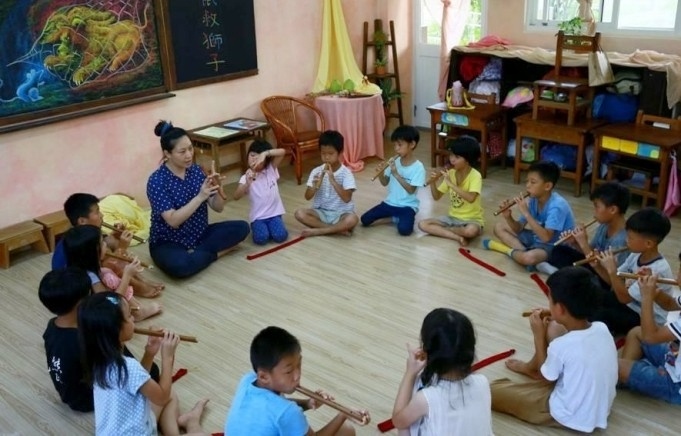
First Grade Music centers on the deep, qualitative experience of sound. Children explore diverse musical moods by listening, singing, and producing sounds with their own bodies—allowing music to serve as a mirror and gentle regulator for their inner development.
To support the dreamlike consciousness of the seven-year-old, music is brought in the “Mood of the Fifth” (pentatonic scale). This open, floating quality of pentatonic music offers a sense of timelessness without rigid tonal endings.
Through fingerplays, rhythmic games, and targeted breathing exercises, children prepare for instrumental work. Students learn seasonal songs by heart through singing first, later bringing those familiar melodies to life on their pentatonic flutes.
◎Games Class
In contrast to the unstructured free play of kindergarten, First Grade Games introduces rule-based cooperative play to guide social and physical growth within a group dynamic.
Rather than encouraging competition, activities are rooted in fun, mutual support, and shared goals. Through engaging group games, children develop dynamic physical coordination, agility, and body control, while learning essential habits of listening to guidance and honoring rules within a community.

◎English
In First Grade, foreign language learning begins with cultural immersion and natural absorption. Designed to expand the child’s perspective and ear for language, early instruction centers on rich, experiential activities—such as traditional songs, movement games, and daily classroom conversation.
By immersing students in authentic language without formal translation, children intuitively absorb vocabulary, natural rhythm, and cultural nuances in a joyful, living way.

◎Food Education
In Grade 1, practical life skills are nurtured through the hands-on preparation of wholesome food. Guided by the natural rhythms of the year, children learn to identify and work with seasonal produce, as well as foundational staple foods like rice and grain.
Through these experiential kitchen activities, students develop basic culinary skills, foster healthy relationships with real food, and build a grounded sense of self-reliance and gratitude for nature’s gifts.

◎Nature Day (Nature Walks)
Every week, First Graders step out of the classroom for Nature Day, exploring the natural world in all seasons and weather conditions.
Walking consistently rain or shine strengthens children’s physical endurance and inner willpower. Immersed in the living environment, students observe the subtle rhythms of the seasons firsthand, developing a deep sense of wonder, curiosity, and respect for nature.

◎Gardening


