
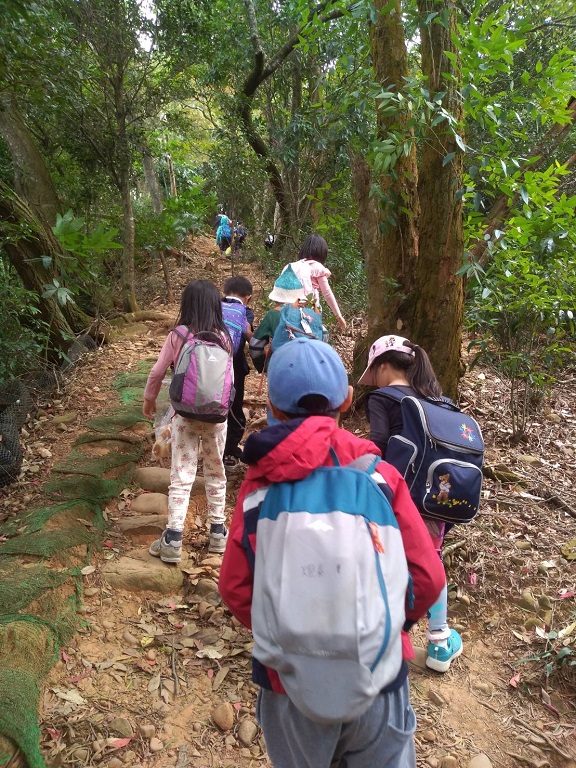
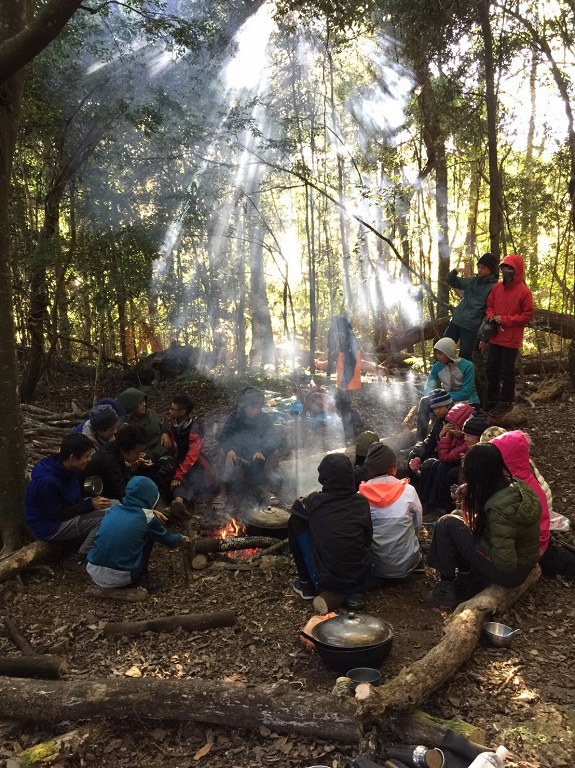
In Grade 1 and Grade 2, we took the children on foot to explore the fields and trails surrounding our school, immersing them in the changing seasons. The young students carried their own butane stoves, canisters, pots, ingredients, and water up the trails to cook their own lunch. Along the way, they marveled at wild flowers, discovered tiny insects, and played among the trees. Walking was a practice built step by step: from asking “Are we there yet?” after just a few strides in Grade 1, to completing a remarkable loop by the end of Grade 2. Starting from the school, they walked to the Dragon’s Head entrance of Feilong Trail near Wu Chuo-liu’s Former Residence, traversed the body of the trail to the Dragon’s Tail Sports Park, descended to County Road 118, looped back along Sansheng Road, and returned to school.
By Grade 3, our focus shifted toward shelter and agriculture. Children learned to construct sheltered spaces using their own strength, even building a treehouse with adult guidance. In farming, we responded to the child’s inner needs through grain cultivation—experiencing the complete journey of rice farming: seed selection, soaking, seedbed preparation, land tilling, field ridge maintenance, transplanting, weeding, hand-picking golden apple snails, water level management, harvesting, threshing, sun-drying, winnowing, milling, and packaging.
In Grade 4, the students stepped beyond the school gates to explore the broader community. We walked into Xinpu Township to discover this historic Hakka town, visiting traditional trades—a local ice shop, a blacksmith, a tofu workshop—and exploring the local market to learn persimmon dyeing. We also introduced the Human & Animal block, where students observed surrounding wildlife to discover their own connection to the animal world. Every outward step of exploration serves a deeper purpose: to help children understand themselves and their inner state, anchoring them with the strength needed to meet the wider world.
This journey led me to reflect continuously: What kind of nature exploration do children truly need when they reach Grade 5? How can we build a cumulative vision that unfolds naturally all the way to Grade 12? Seeking an alternative to goal-oriented, summit-focused mountaineering, I joined our Grade 7 and Grade 8 students and Teacher Shan-Lu’s guide team along the Xiakelo National Trail during autumn break. This 22-kilometer trail sits at an elevation of roughly 1,700 meters. While most hikers complete it in a single day from one trailhead to the other, we spent five whole days living deeply in the mountains, truly experiencing and learning from the wilderness. Before setting off, I felt a mix of anticipation and anxiety about the unknown path ahead. Yet I knew I would return transformed—ready to let events unfold naturally and accept with joy every gift from above.
Day One: Setting Off
Before dawn, we gathered at Tsio Hai to distribute shared food and trail snacks—fruits, nuts, and crackers. We packed only essential gear, keeping weight to a strict minimum as everyone carried their own backpack throughout the trek. My pack weighed nearly 12 kilograms, while the students’ packs ranged from 10 to 11.8 kilograms. Guides taught us how to hoist our packs, adjust the fit, and distribute weight evenly. Carrying this load while hiking made us acutely aware of the need for physical conditioning and muscle strength. Once geared up, we traveled by bus to the Yangle trailhead of the Xiakelo National Trail. After a quick snack and a warm-up stretching session led by our guides to regulate our breathing, we stepped into the forest.
Once inside the mountains, time ceased to exist. Watches were forbidden, allowing children to move with the natural flow of the group—eating when hungry, sleeping when tired. With no phone signals or internet, we were simply present with nature, with one another, and with ourselves.
Mountain Reverence Ceremony
Our six guides divided us into five small groups of 5–6 people, each led by a guide. Group members lined up according to their stamina: those with less experience or physical strength walked near the front, while the strongest brought up the rear to offer support. Every hiker looked out for one another, passing warnings about trail hazards and voicing needs as they arose. Teacher Shan-Lu asked the students to hike in silence, focusing solely on walking, regulating their breath, and tuning into their inner selves. Remarkably, the Grade 7 and 8 students exercised great self-control, holding back the urge to chat while walking, though quiet conversations resumed during rest breaks.
A short distance in, at a wider bend along the trail, Teacher Shan-Lu arranged wild flowers, fallen fruit, feathers, and a shed snake skin on the ground. Uncorking a small bottle of sorghum liquor, we paused to offer prayers to the mountain spirit—asking permission to enter the forest, to learn from nature, and to be granted safe passage. One by one, we made our sacred covenant with the mountain, sprinkling liquor into the air and onto the earth with sincere hearts, trusting the mountain spirit to watch over us.
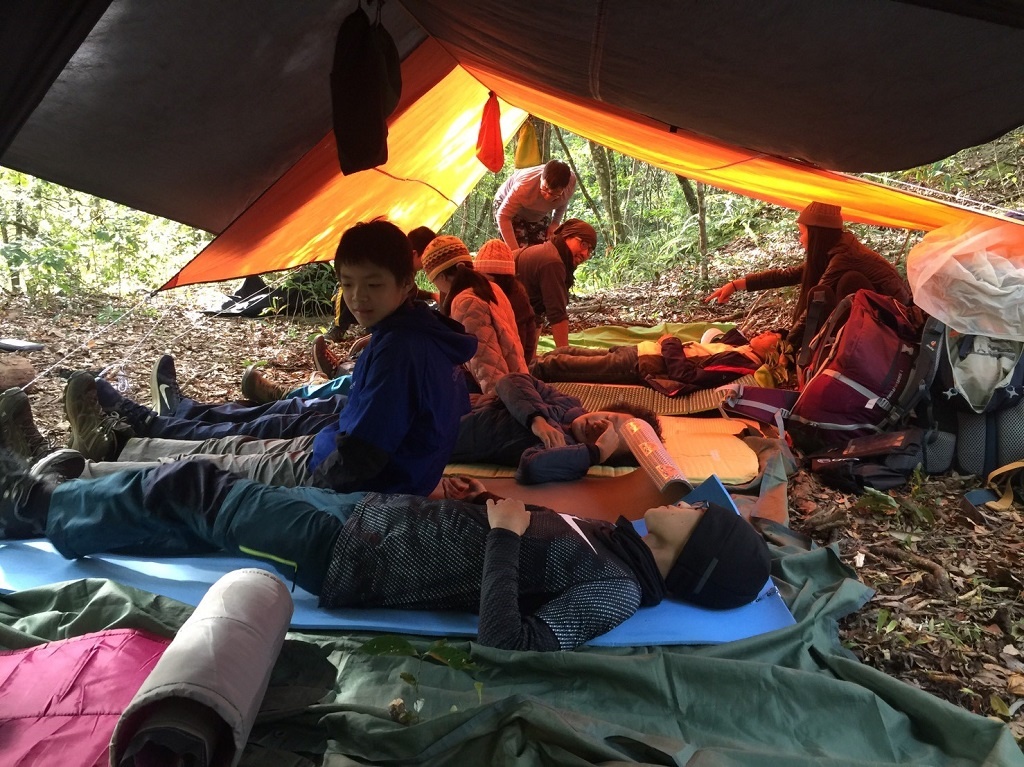
We continued onward to Ma-An at the 17-kilometer mark—a pair of flat clearings that once housed a Japanese-era police post, later served as a mushroom farm, and have now returned to wilderness. After a brief snack, Teacher Shan-Lu taught us how to pitch a tarp shelter in the wild. We selected level, safe ground with sturdy anchor points for our ridge lines, tied thick ropes between tree trunks, draped tarps overhead, and staked out tension lines to form a cozy shelter. Beneath us lay a thick natural carpet of fallen leaves and pine needles, covered by a light canvas sheet and our sleeping pads, creating a surprisingly comfortable and simple resting space. That first night inside my sleeping bag, I slept so warm I had to stick my head and hands out to cool down.
Making Fire by Friction
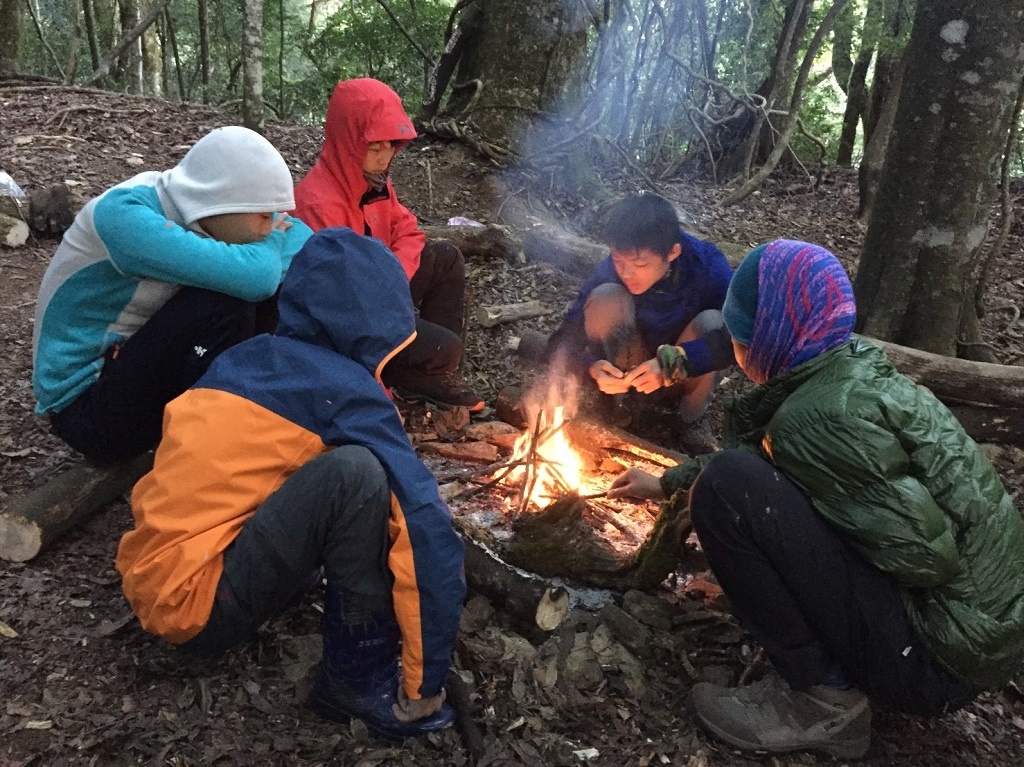
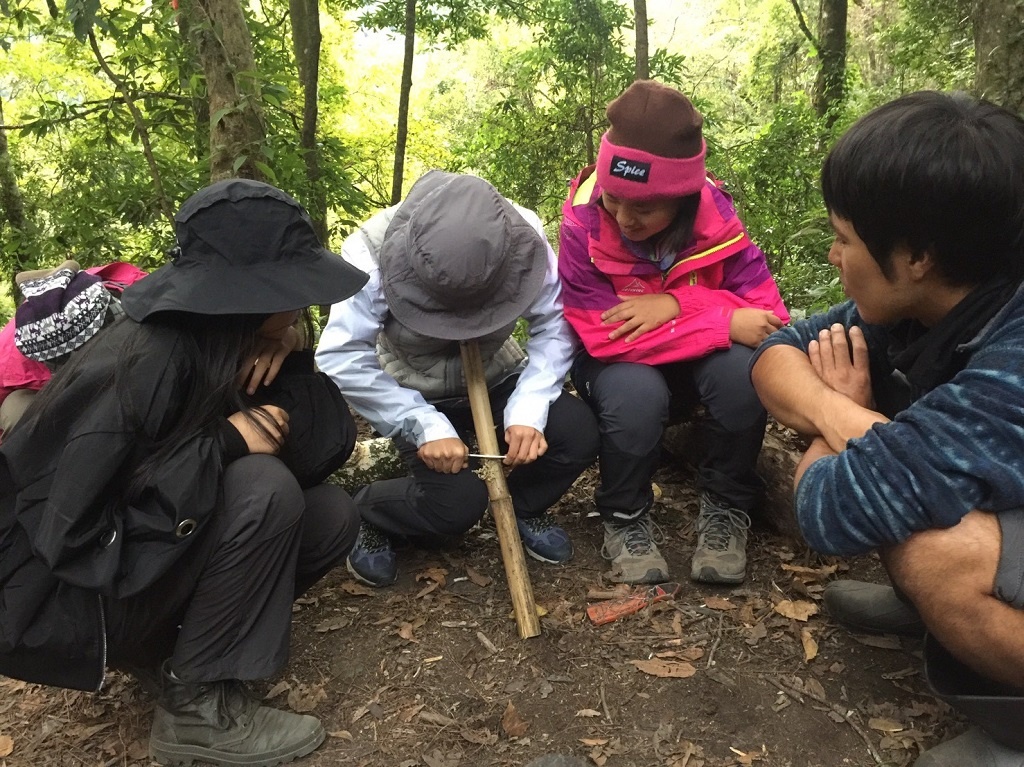
Once our sleeping area was set up, we turned our attention to preparing dinner, dividing into small teams to carry out the work. Some went to the nearby stream to fetch water, others gathered firewood, and another group prepared the campfire pit—arranging stones to encircle the hearth and hauling heavy logs to serve as seating around the fire. Collecting firewood required keen attention: we looked for dry, solid timber and sorted the branches by thickness for easy access. We also practiced using knives to shave fibers from dry bamboo bark, overlapping the delicate strands to craft a ball resembling a bird’s nest.
When everything was in place, we gathered around the unlit fire pit, quietly watching Teacher Shan-Lu prepare the wood structure. He started with fine leaves in the center as tinder, checked the wind direction to determine where to leave an opening, and stacked thin sticks around the core in a teepee shape, gradually adding thicker logs over the top.
The most critical moment was making fire by friction. Teacher Shan-Lu brought out a bag containing a rectangular wooden block with several carved holes, a wooden spindle, a saucer-like wooden hand-socket, and a fire cord. Before beginning, he offered a prayer to the mountain spirit, asking permission to ignite a fire and requesting its warmth. He reminded the children that in nature, we cannot simply act out of whim—there are unseen forces around us, calling for reverence. This stood in stark contrast to our modern daily lives, where lighters, butane stoves, and gas burners deliver fire instantly, often disconnecting us from the natural world. Reconnecting with nature and rethinking our taken-for-granted conveniences was one of the most precious gifts of this journey, naturally inspiring a profound sense of gratitude.
We watched Teacher Shan-Lu kneel bare-kneed on the ground, holding down the wooden socket over the spindle—a central rod rounded at both ends. Two guides held opposite ends of the fire cord, pulling back and forth in rhythmic harmony. Surrounding them, we sang a joyful Atayal song.
Success did not come on the first try. As we made multiple attempts, Teacher Shan-Lu reminded us how much our collective mindset mattered: if we truly believed in the power of natural elements and held a shared wish for fire, the fire would come; but if anyone harbored doubt or felt detached from the circle, the flame would remain elusive, and we would have to settle for trail snacks. As our intentions aligned and our voices merged into one song, white smoke began to curl upward—the “Fire Child” had arrived.
Teacher Shan-Lu carefully cupped the tiny glowing ember in his hands, placed it inside the ball of bamboo fibers, and blew gently upon it. A tiny spark caught, flared into a living flame, and was slowly transferred into the campfire structure. The light and warmth illuminated the surrounding forest, and we watched in spellbound silence as the flames danced in vibrant colors—a moment of breathtaking, awe-inspiring beauty.
Once the fire reached a steady heat, the guides began cooking over the flames. For our first night, we had vegetable miso noodle soup. Everyone pooled their bowls together so the guides could ladle out the portions. The bowls were then passed from hand to hand around the circle—not taken greedily, but received with care and passed along. Holding a warm bowl in the cool night air brought a deep sense of contentment.
Teacher Shan-Lu guided us to trace the journey of the food in our hands: the ingredients came from the earth, nurtured by sunlight, air, and water; the food itself was carried up the mountain on everyone’s backs; the three large pots and ladles were carried by the guides; and the wood, fire, and water were gathered through shared effort. Every bowl of noodles was a tangible gift of collective labor. Filling our hearts with gratitude before taking our first bite warmed us from the inside out. Not a single child complained or left food behind; everyone chewed every bite mindfully. Though we couldn’t see clearly what our spoons held in the dark, our senses grew sharper—savoring the sweetness of the vegetables, the aroma of the noodles, and the rich depth of the miso. Because water was scarce, we cleaned our bowls by pouring in a splash of water, swirling it around, scraping the edges with our spoons, and drinking it down like a final sip of broth, before drying our bowls near the warmth of the fire.
After a short rest, we gathered around the fire to listen to Teacher Shan-Lu tell stories. He invited each of us to choose a “nature name” for ourselves at this stage of life, and the guides shared the stories behind their own nature names, helping us know our mentors more deeply. It was a warm, blessed evening. Late into the night, without knowing the hour, we sang an Amis lullaby together, wished one another goodnight, and crawled into our sleeping bags.
To be continued…
Teacher Hsiao-Ling
> Day Two
> Day Three
> Day Four
> Day Five
> Epilogue: Reflections & Actions